

Article
How Small Farms Can Think Like Professional Sheep Operations
A small sheep farm does not need to become large to become more professional. Better records, routines and cost awareness can change decisions.
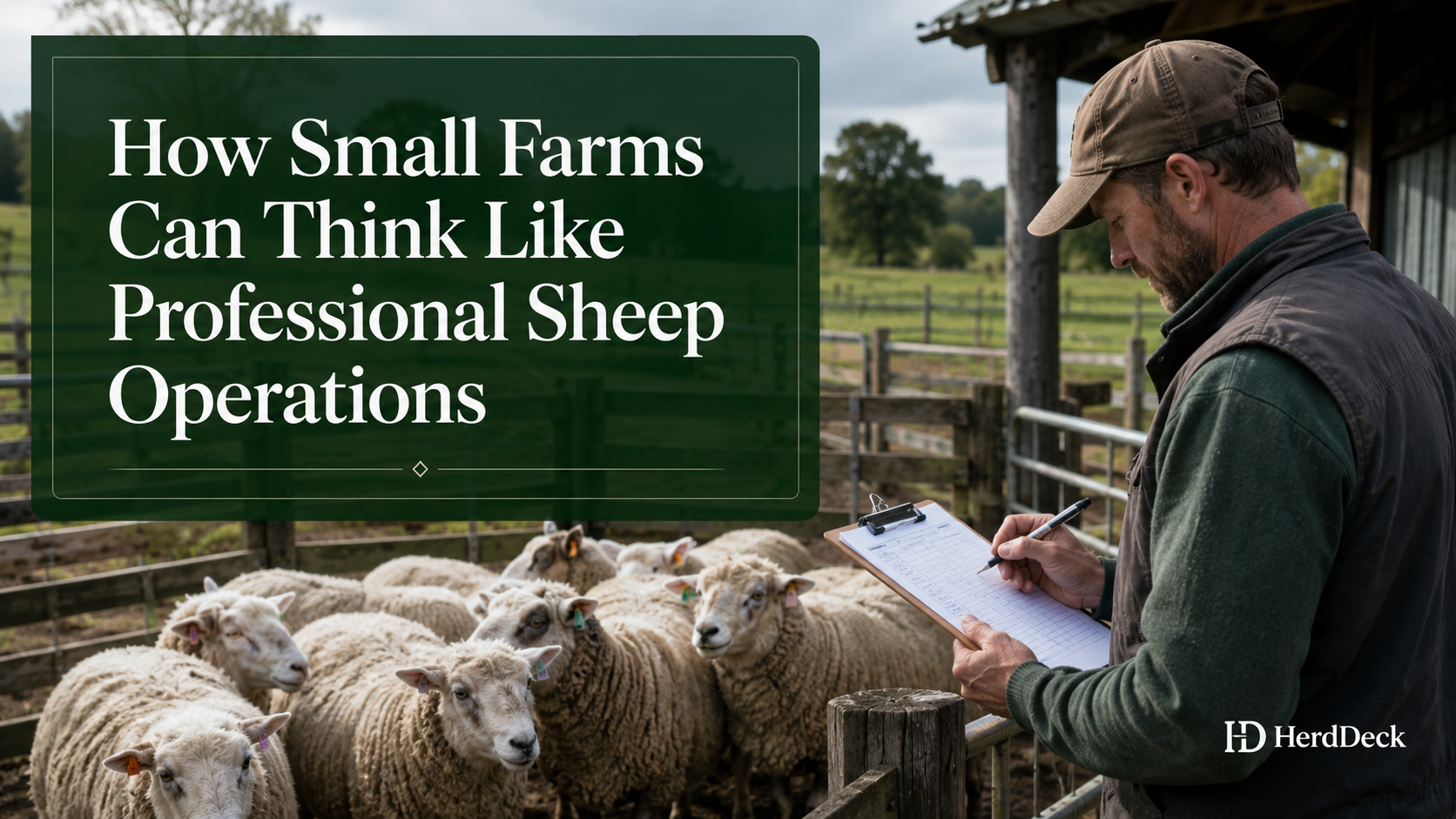
A small sheep farm does not need to become large to become more professional. Better records, routines and cost awareness can change decisions.
A small sheep farm does not need to become a large farm to become more professional.
Professional management is not about owning expensive buildings, hundreds of animals, or complicated systems. It is about making decisions from observation, records, routines, and clear priorities instead of memory, habit, or panic.
Many small farms already do the hard part well. They know their animals closely. They notice behavior. They understand the land. They work with limited time, limited labour, and limited money. But small farms often lose value because the information stays in someone’s head instead of becoming a usable management system.
A professional sheep operation does not simply ask, How many sheep do I have? It asks better questions.
Which ewes raised strong lambs? Which lambs grew slowly? Which animals needed repeated treatment? Which feed change improved results? Which sheep cost more than they returned? Which problems happened again this season?
These questions are not only for large farms. In fact, they may be even more important for small farms, because one weak ewe, one poor feeding decision, or one preventable lamb loss can affect the whole year.
The first professional habit is identification. Every animal should be easy to recognize. Ear tags, names, numbers, group labels, or simple written descriptions all help. The method can be simple, but the goal is serious: a farmer should not have to guess which animal had a problem last month.
The second habit is keeping records that are actually useful. Small farms do not need to record everything. They need to record the things that change decisions: breeding dates, lambing results, lamb survival, treatments, weights, body condition, deaths, sales, purchases, feed costs, and culling reasons.
A notebook is better than memory. A spreadsheet is better than scattered notes. A proper flock system is better when the farm grows or when multiple types of information must be connected. The tool matters less than the discipline. The point is to create a history the farmer can return to.
The third habit is measuring performance per ewe, not only per flock. A flock can look acceptable overall while certain animals quietly reduce profit. One ewe may lamb every year and raise strong lambs. Another may miss a season, lose lambs, require treatment, or stay thin despite good feeding. Without individual records, both animals may look similar at a distance.
This is where professional thinking changes the farm. The question becomes not only Did we have lambs? but Which ewe produced them, how well did she raise them, and what did it cost?
The fourth habit is planning before the busy season. Lambing, breeding, weaning, shearing, vaccination, parasite control, feed buying, and sales should not arrive as surprises. A professional operation uses a calendar. Even a simple wall calendar can prevent expensive mistakes.
The aim is not to make the farm bureaucratic. The aim is to reduce emergency management. When routine work is planned, the farmer has more attention left for real problems.
The fifth habit is watching body condition. Weight is useful, but it is not always practical or clear, especially in wool sheep. Body condition scoring helps the farmer understand whether ewes are too thin, too fat, or close to the right condition for breeding, pregnancy, lactation, or recovery.
A professional farm does not wait until sheep look obviously poor. It checks earlier. Thin ewes before breeding, overfat ewes before lambing, or weak animals after lactation are not just individual problems. They are signs that feeding, grouping, health, or management may need adjustment.
The sixth habit is separating animals by need when possible. Small farms often keep mixed groups because space is limited. That is understandable. But professional thinking asks whether every animal in the group really has the same needs.
Growing lambs, pregnant ewes, lactating ewes, dry ewes, rams, thin animals, and sick animals should not always be managed as if they were equal. Even temporary grouping can improve feeding, reduce competition, and make health problems easier to notice.
The seventh habit is treating health as a system, not a reaction. Many farms only write down disease when treatment is needed. A professional operation also asks why the problem appeared. Was it feed? Weather? Housing? Parasites? Purchased animals? Dirty bedding? Poor ventilation? Overcrowding? Stress?
The goal is not to replace the veterinarian. The goal is to give the veterinarian better information and to prevent repeated problems from becoming normal.
The eighth habit is calculating cost honestly. Small farms often underestimate cost because family labour, homegrown feed, fuel, small purchases, medicine, losses, and time are not always counted. But profit does not come from selling lambs alone. Profit comes from the difference between what the farm produces and what it truly costs to produce it.
A professional small farm should know its basic numbers: feed cost, medicine cost, purchase cost, sale income, lamb survival, average sale weight, and which groups are profitable. These numbers do not need to be perfect at first. They need to be visible.
The ninth habit is culling with reasons, not emotions alone. Keeping animals because they are familiar is understandable. But every farm has limited feed, space, and attention. A ewe that repeatedly fails to raise lambs, stays thin, has chronic feet problems, or needs constant care may be costing more than she returns.
Professional farms do not cull blindly. They cull with records, reasons, and timing. They also know which animals are worth keeping, because the good animals have a history too.
The tenth habit is improving one thing at a time. Small farms do not need to rebuild everything in one season. They can start with one useful change: record lambing results, check body condition, mark treated animals, weigh lambs at weaning, track feed purchases, or write down culling reasons.
Small improvements compound. A farm that records lambing this year can make better replacement decisions next year. A farm that tracks treatments can notice repeated health problems. A farm that measures feed cost can understand whether a ration is truly economical. A farm that knows which ewes perform well can build a stronger flock over time.
Professional sheep farming is not about size. It is about clarity. A small farm can think professionally by knowing its animals, recording the right information, planning routine work, checking condition, controlling costs, and learning from each season. The flock may be small. The decisions do not have to be casual.