

Article
How to Prevent Feed Competition in Mixed-Age Sheep Groups
Mixed-age sheep groups can hide feed competition. Feeder space, grouping, timing and observation help weaker animals get what they need.
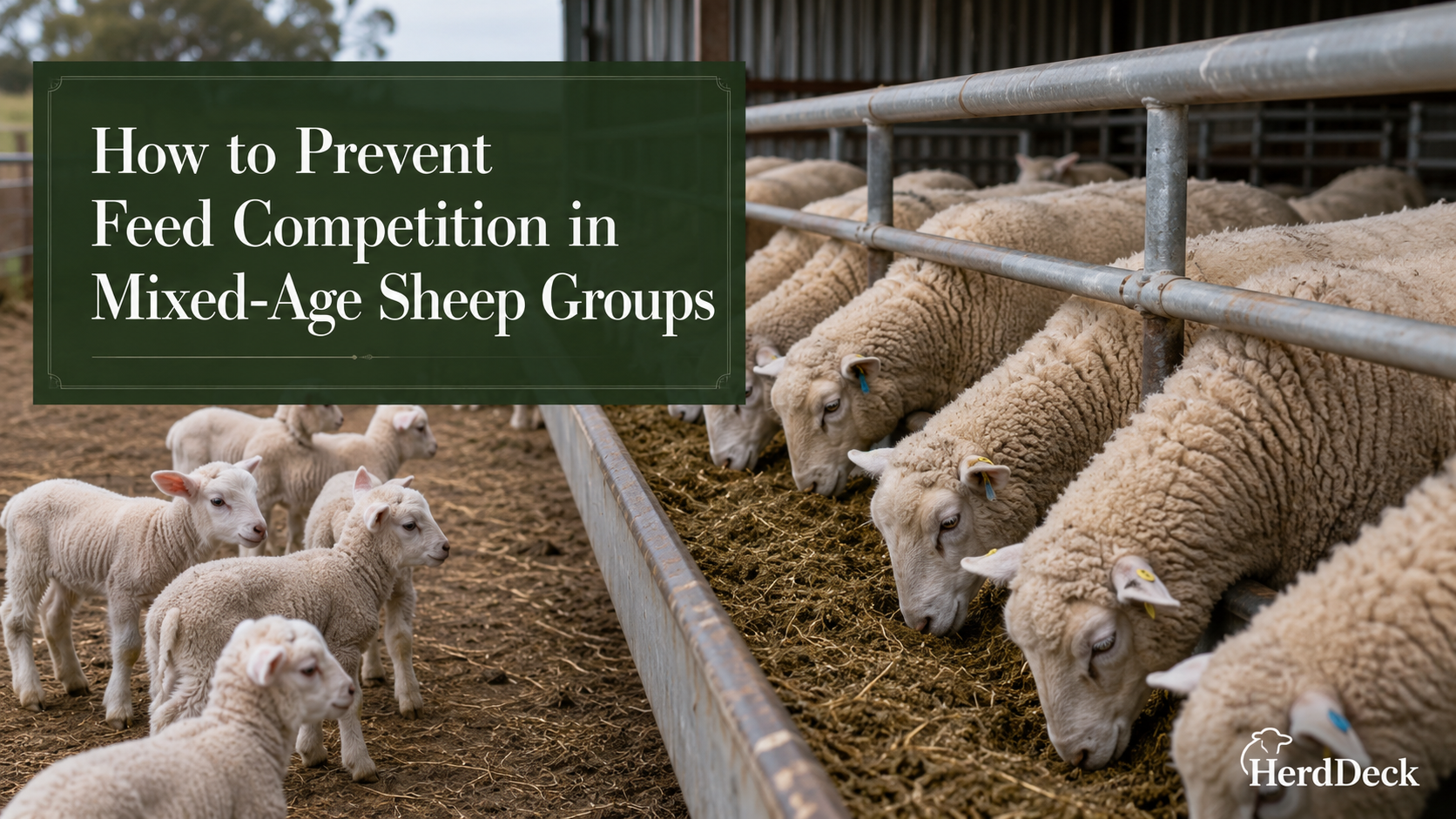
Mixed-age sheep groups can hide feed competition. Feeder space, grouping, timing and observation help weaker animals get what they need.
On many small sheep farms, different ages and sizes often share the same pen: ewes, ewe lambs, growing lambs, weak animals, and sometimes rams. This is practical, but it creates one of the most common feeding problems in a flock: the animals that need feed the most are not always the animals that get enough of it.
Feed competition does not always look dramatic. It is not only pushing, fighting, or chasing. Sometimes it is quiet. A young ewe waits at the back. A smaller lamb takes a few bites and walks away. A shy animal stands near the feeder but never really eats properly. From a distance, the flock looks fed. In reality, the strongest animals may be eating first, eating longer, and eating the best parts.
This matters because mixed-age groups are not nutritionally equal. A mature dry ewe, a growing lamb, a heavily pregnant ewe, and a thin animal recovering from illness do not have the same needs. When they all compete at the same feeder, the ration you planned on paper may not be the ration each sheep actually receives.
The first rule is simple: watch the feeder, not only the feed bag. If you put feed down and leave immediately, you only know what was offered. You do not know who ate it. Stay for a few minutes and look for the animals that approach late, step away quickly, or circle around without finding space. These are often the first animals to lose condition.
The second rule is feeder space. When feed is limited and animals are expected to eat at the same time, every sheep needs enough room to put its head in and eat without being pushed out. If there is not enough feeder space, dominant animals do not simply eat their share. They control access. They move along the feeder, push others away, and return for more. The result is uneven intake: some animals become overfed, while others fall behind.
A very practical solution is to spread feed across more than one place. Two smaller feeding lines are often better than one crowded feeder. If the group is mixed, placing feed in separate sections can reduce pressure on the weakest animals. The goal is not elegance; the goal is access.
The third rule is grouping. Perfect grouping is not always possible, especially on small farms, but even temporary grouping helps. Thin ewes, young replacements, late-pregnant ewes, weak lambs, and animals recovering from disease should not always be expected to compete with large, confident animals. Even a simple priority pen can make a big difference.
If separation is impossible, create protected access. Creep areas for lambs, lower-pressure corners, extra hay points, and wider feeding space can help smaller animals eat without being constantly displaced. The same logic applies to water: a crowded feeder plus a single dirty water point is a recipe for silent underperformance.
The fourth rule is timing. Hungry animals compete harder. If concentrates are fed once a day in a crowded place, the first few minutes can become a battle. Splitting feed into more than one feeding, or offering forage before concentrates, can reduce the intensity of competition. The right choice depends on the farm, but the principle is the same: reduce pressure at the moment of feeding.
The fifth rule is to monitor the animals most likely to lose. These are usually younger animals, smaller animals, thin animals, lame animals, timid ewes, and late-pregnant or lactating ewes. They may not look sick. They may simply be losing the daily contest at the feeder.
Body condition scoring is useful here because weight alone can be misleading, especially across age, breed, pregnancy stage, and fleece cover. A sheep can look acceptable under wool while slowly losing condition. Hands-on checks help reveal what the eye misses.
The warning signs are easy to miss: uneven body condition, lambs growing at different speeds, animals waiting instead of eating, feed left in corners but not in the main feeder, or the same sheep always controlling the feeding line.
A mixed-age group can work, but only if the feeding system is designed for the weakest animal, not the strongest one. The strongest animals will usually manage. The question is whether the quiet ones are getting what they need.
Good flock feeding is not only about ration formulation. It is about delivery, space, timing, grouping, and observation. The ration begins in the feed bag, but it only becomes useful when every animal that needs it can actually eat it.