

Fun Fact
A Flock Moves Like One Animal, But Decides Through Many Small Signals
A flock may look like one animal, but sheep move through many small signals, social cues and group reactions.
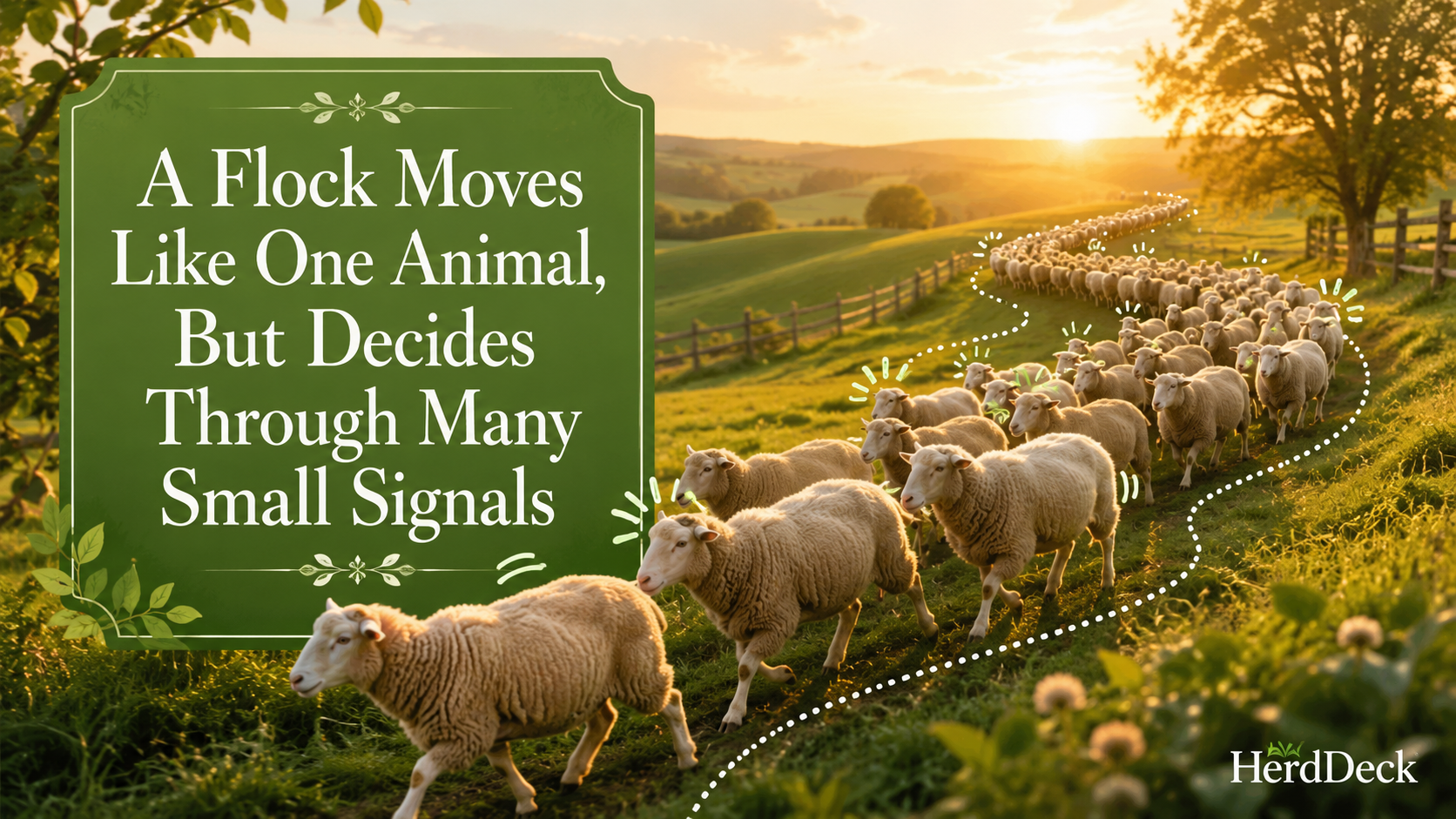
A flock may look like one animal, but sheep move through many small signals, social cues and group reactions.
From a distance, a flock of sheep can look like one single animal. It turns, slows, stretches, gathers, and moves across a field as if one mind is controlling it. But a flock is not one mind. It is many small decisions happening very quickly.
Sheep are strongly social animals. They tend to remain in groups, synchronize behavior, and adjust their position to maintain cohesion with other sheep. This is why one movement can become many movements. One sheep lifts its head. Another notices. A few animals step forward. Others follow. The flock changes shape. What looks like a single decision is often a chain reaction.
This flocking instinct is one of the reasons sheep are manageable in groups. It helps them stay together while grazing, moving through gates, or reacting to pressure from a shepherd or dog. But it can also create problems. If one animal panics, others may panic before they understand the cause. If a few animals hesitate at a gate, the whole group may stop.
The interesting part is that leadership in a flock is not always fixed. In some situations, one animal may appear to lead, but in other moments another animal influences the movement. Leadership can shift over time. A flock may follow one animal for a moment, then another in the next movement.
For farmers, this matters because handling sheep is not only about force. It is about reading pressure, space, and direction. A flock moves best when the animals believe the movement is possible. If the front animals see a dark doorway, a sharp corner, a noisy object, or a person standing in the wrong place, they may stop. When they stop, the rest of the flock piles up behind them.
Good handling uses the flock’s own behavior. Instead of pushing harder from the back, a calm handler looks at what the front animals are seeing. Is the gate wide enough? Is there light ahead? Is the path clear? Is one animal blocking the turn? Is the pressure coming from the wrong angle?
The flock is constantly reading small signals: where other sheep are looking, which animals are moving, where pressure is coming from, where there is space, and whether the route feels safe. Humans often miss these signals because we look at the group as a mass. Sheep experience the group from inside it.
This is also why routine matters. Sheep remember routes, feeding places, gates, and handling patterns. A calm routine can make movement easier. A chaotic routine teaches the flock that handling is something to resist.
The same flocking instinct that helps sheep stay safe can also hide individual problems. A lame sheep may follow the flock until it can no longer keep up. A sick sheep may remain with the group but stand slightly apart. A weak lamb may move with the flock but lose ground over longer distances. Farmers should not only watch the flock as a whole; they should watch the animals at the edges, the back, and the slow corners.
A flock may look like one animal, but the details are in the small signals. The first head that lifts. The ewe that hesitates. The lamb that stops early. The group that bends around pressure. The calm animal that others follow.
Understanding sheep movement is not just a fun fact. It is a practical skill. Farmers who read flock behavior well can move animals with less stress, find problems earlier, and avoid turning every handling job into a battle. The flock speaks quietly. The good shepherd learns to notice before the whole group reacts.